MCP is in its Yahoo era
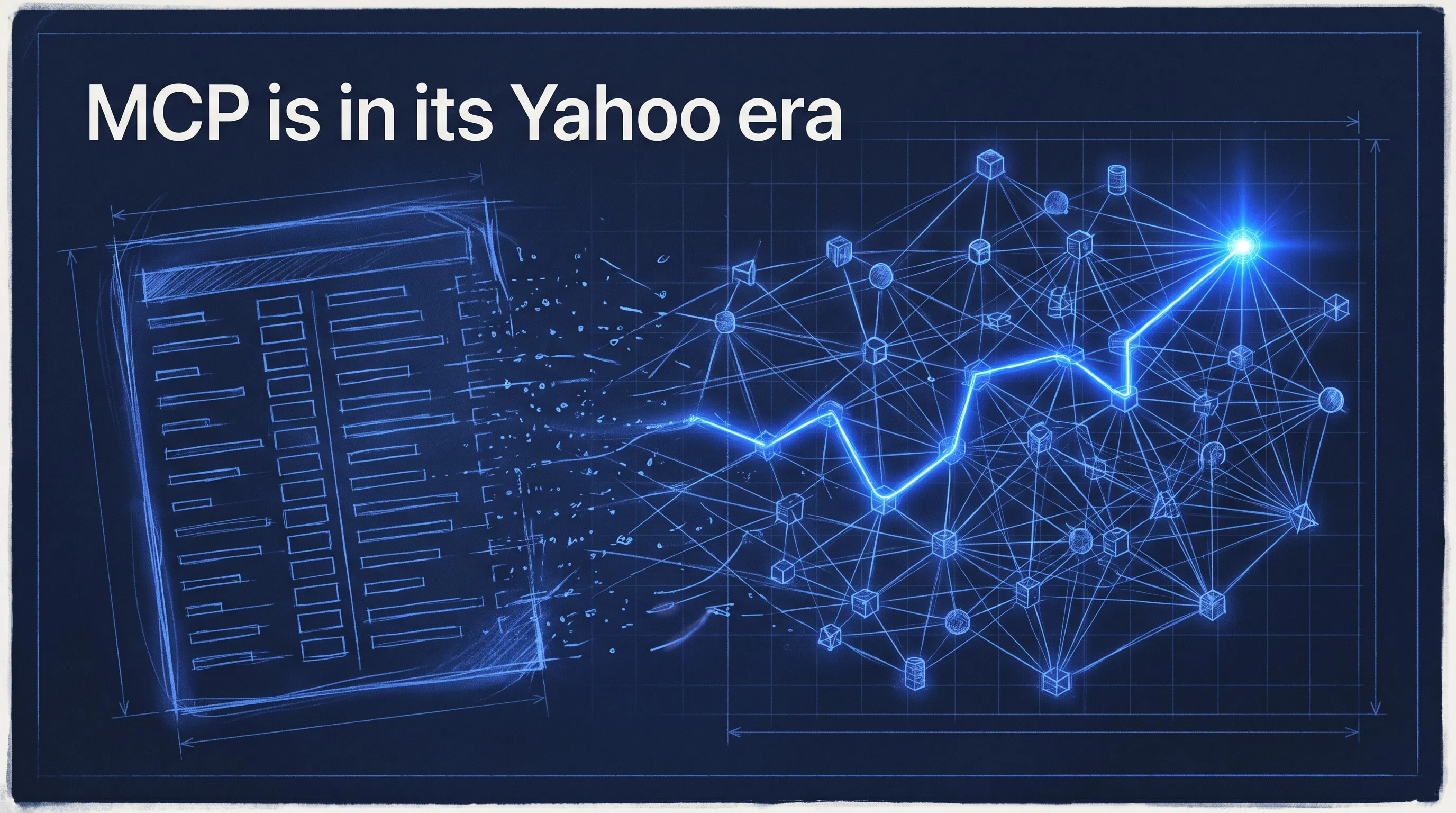
Using MCP today feels a bit like the web in 1996. You want Claude or ChatGPT to use a tool? You open settings, find the connector, paste a URL and click through a login. One server at a time, by hand. That works while there are a few hundred servers worth knowing about. It won’t work when there are millions, and I’m fairly sure there will be millions.
We’ve been here before
In the early web, Yahoo was a directory. Real people sorted websites into categories, and you browsed the list to find what you needed. It was lovely, and it collapsed the moment the web got big. Search took over, and nobody has picked a website from a list since.
The connector list in your AI app is that directory. It’s going away too. What I keep coming back to is what replaces it.
The idea: search for agents
You say what you want: “order my usual groceries”, or “find me a flight to Vancouver under $400”. Your agent asks one service a single question, “who can do this?”, and gets back the servers that can, ranked. It picks one and gets on with it. You never see a server name unless you ask for one.
A server ranks well when its tools are described well enough for a machine to use them, when it actually answers, when the call finishes the job, and when the door is locked with real authentication. The same service shows a server’s owner how often agents picked it for the requests it could handle. That selection rate is the new search ranking, and I expect every serious MCP team to track it by 2028.
The pieces are already showing up: registries, plus drafts that let any website announce its MCP server the way it publishes a sitemap. Once that settles, every business with a website will have an MCP face as well. Someone has to index and rank them, and I’d rather it was an open service any agent can ask.
Why now
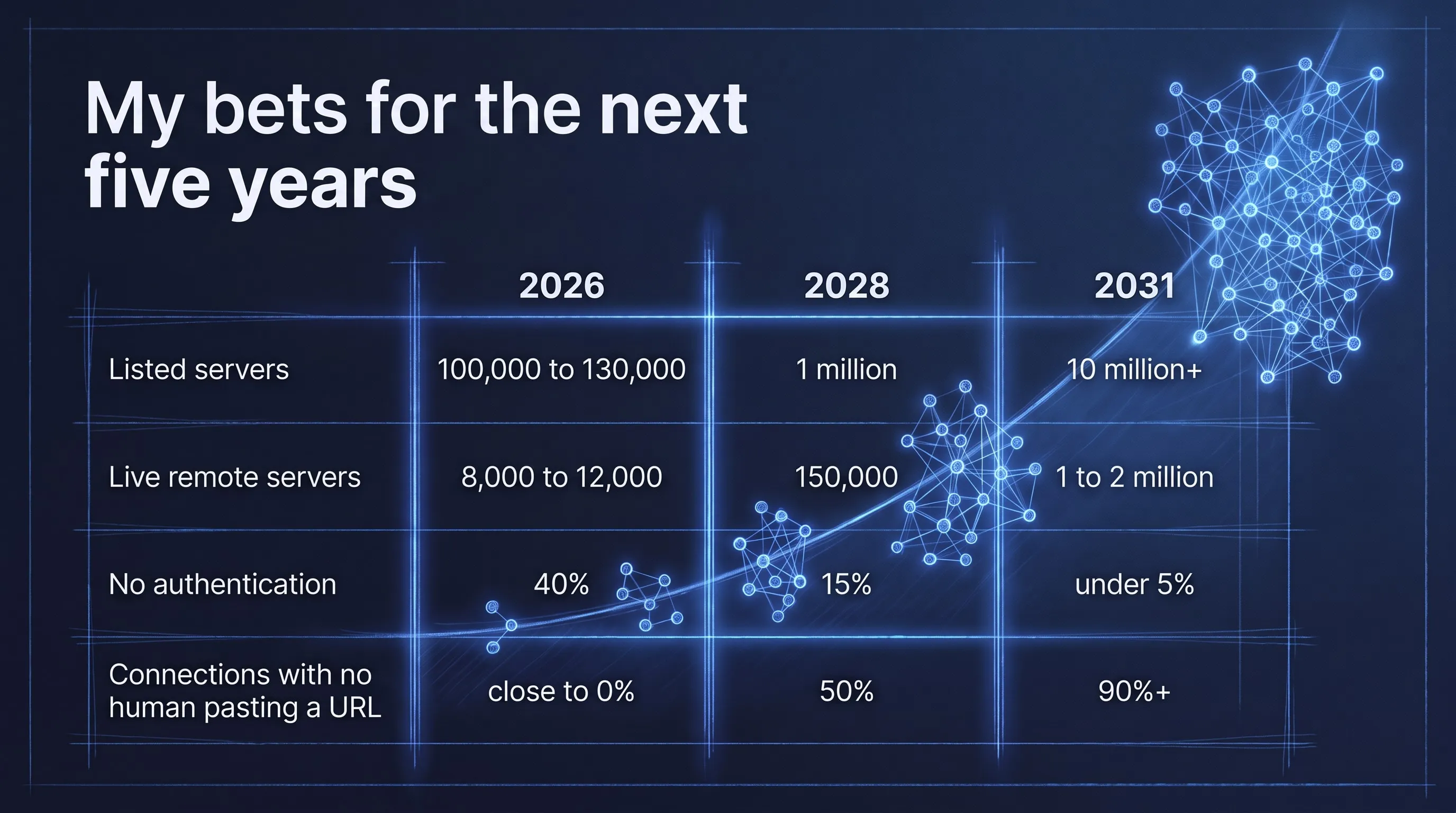
I went looking for hard numbers, and the first thing I learned is that nobody agrees on them. As of October 2026, Glama lists about 95,000 servers and more than 900,000 tools, and MCP Toplist counts about 133,000 servers. Yet an academic team that probed the internet confirmed 7,973 live remote servers, and Censys counted 12,520. More than 100,000 listings, roughly 10,000 servers that actually answer: that gap is the junk problem, and it’s already here. A ranking service is how you live with it.
One more number bugs me. In that same study, about 40% of live remote servers asked for no authentication at all, and only about 30% used OAuth. We’re building the agent economy on a lot of unlocked doors.
And the curve is steep. The MCP Dev Summit keynote in April 2026 put monthly SDK downloads at 110 million. On the web, Netcraft counted about 18,000 sites in August 1995 and 10 million by February 2000; my bets below assume MCP grows at about a tenth of that pace. The trigger will be the one the web had: publishing becomes automatic. The day the big CMS and e-commerce platforms switch on an MCP endpoint by default, thousands of hand-built servers become millions of generated ones.
The hard parts
Discovery will get solved. These worry me more, and whoever builds this has to answer them:
- Trust. How does a supplier know my agent really acts for me, and how far my permission goes?
- Blame. When my agent orders the wrong thing, who pays? Me, the supplier, or the AI company?
- Manipulation. A million servers is a million chances to trick an agent. Expect dark patterns designed for machines instead of people.
- Gatekeepers. If three AI hosts decide which servers get picked, we’ve rebuilt the app store, toll booth included.
- Junk. Most of those million servers will be abandoned or bad, like most websites.
SEO for agents is coming too: people will tune their tool descriptions so models choose them, and someone will sell sponsored placement. I’m not thrilled about it, but I’d be shocked if it didn’t happen.
Where to start
Two numbers would sit at the top of my dashboard. Auto-discovery share: what percent of connections happened without a human pasting a URL? When it passes 50%, the Yahoo era is over. And selection rate: for the requests your server could handle, how often did an agent pick you?
If you’re building an MCP server today, my advice is simple. Stop thinking about how to get users to install you. Start thinking about how to get picked by an agent that has never heard of you. Lock the door with real authentication, describe your tools for machines, and measure whether calls actually succeed.
The directory era is ending. The ranking era hasn’t started yet. That gap is the best time to build.
If you’d like to build this, with me or without me, or to help fund it, I’d love to hear from you.