MCP servers for websites in 2026: 44 tools, sorted by who runs them
Here’s a question I kept turning over: could any AI agent search a website and ask it questions, the way a visitor would, without the owner building anything special? The Model Context Protocol (MCP) is the obvious way in, so in the first week of October 2026 I went looking for every service, platform and open-source project that puts an MCP server in front of a website’s content, for personal sites, small businesses and enterprises alike. I found more than I expected: 44 tools and two standards, each checked against its own documentation or repository on 7 October 2026. The most useful way to sort them turned out to be one plain question: who runs the server?
In MCP is in its Yahoo era I guessed that every business with a website will have an MCP face. This is how far along that is.
In brief
- Who runs the server is what sorts them. A server the site owner publishes shows what the owner chooses. A server the agent’s user runs crawls someone else’s site, and the owner has no part in it.
- On some platforms you already have one. Every Wix site, every Shopify store, every published GitBook site and every Mintlify site gets an MCP server from the platform, at a fixed address, with no setup.
- Hosted services work on any site, inside their own stack. Cloudflare AI Search wants your domain on your Cloudflare account; CustomGPT.ai, SiteSpeakAI and Kapa.ai add one to a chatbot or assistant built from your site; Azure AI Search turns each knowledge base into a server.
- Open source that the owner runs is real but scattered. NLWeb is the project built as a public “ask this site” endpoint. Retrieval-augmented generation (RAG) platforms and search engines can serve a site over MCP once you’ve crawled it into them.
- Most content management system (CMS) plugins are editing tools behind a login. They’re built for the site’s own team, not for a visitor’s agent.
- Discovery has just taken a step. MCP Server Cards became a final proposal on 6 October 2026, and WebMCP is in a Chrome trial. For now, someone usually still has to give the agent the address.
- One layer is still missing: one that works on any platform, is run by the site owner, keeps content in sync, lets the owner choose what’s exposed, shows what agents ask and publishes discovery files. A closed beta pitches it; nothing established does it yet.
Who runs the server
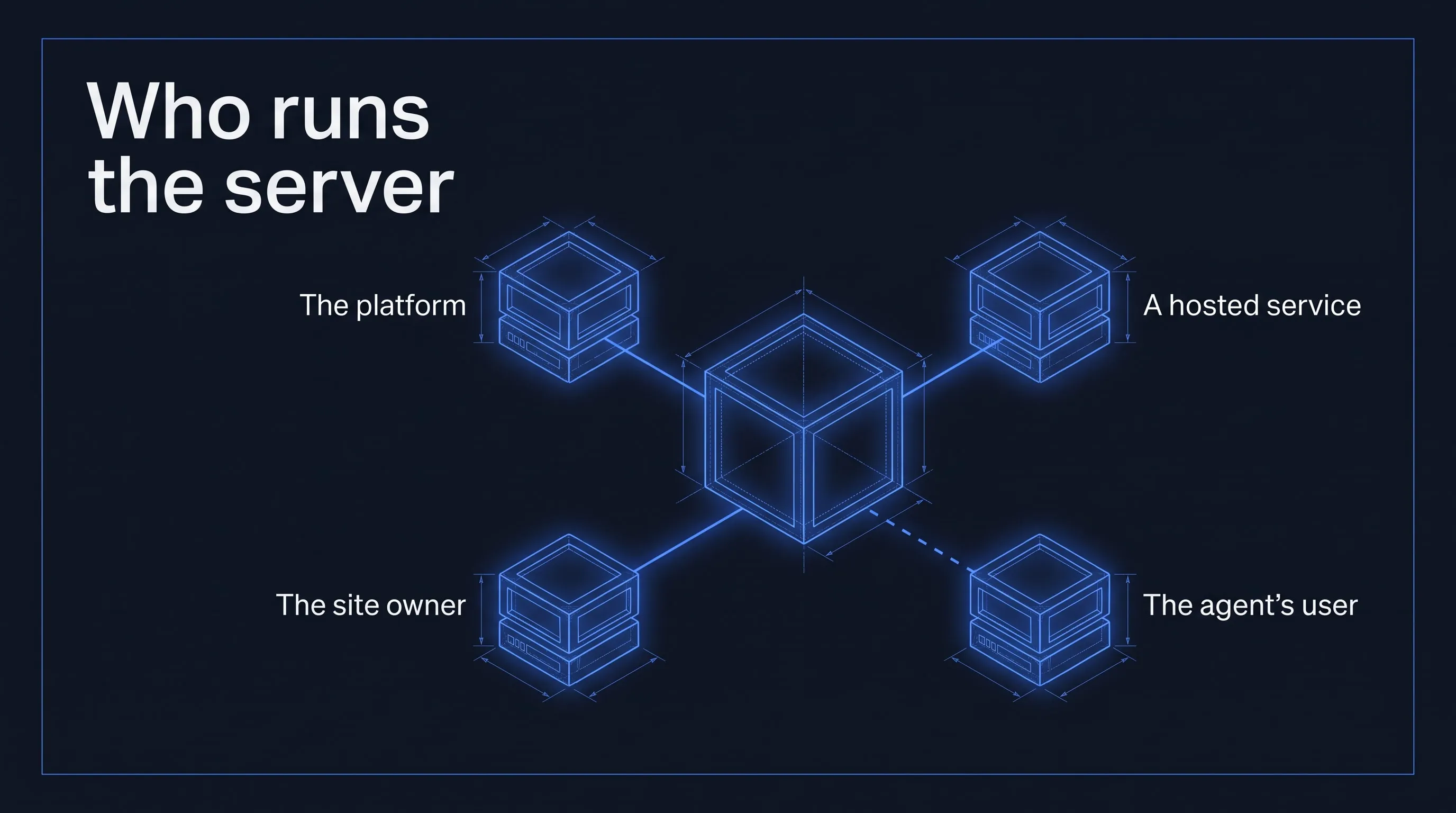
An MCP server for a website can be run by four different parties, and that choice decides what an agent can see and who is in control of it.
- The platform. Wix, Shopify, GitBook and Mintlify switch one on for every site they host. No setup, but only for sites hosted there.
- A hosted service. You point a service at your site and it hosts the server for you.
- The site owner. You run open-source software, a CMS plugin or a docs framework, and you decide what it exposes.
- The agent’s user. Someone who wants to ask your site questions crawls it into a local index and serves it to their own agent. You aren’t involved.
Here are the 44, grouped that way.
Counted by group, the three groups the site owner runs hold 24 of the 44 tools, and 14 of those serve documentation or a CMS’s own team.
Built into the platform
If your site lives on one of these platforms, you may already have an MCP server without having done anything. The catch is that each one only covers sites hosted there.
| Platform | Address | What an agent can do |
|---|---|---|
| Wix | yoursite.com/_api/mcp | Search the site, get business details, and take actions such as booking an appointment. Any visitor’s agent can use it without authentication. |
| Shopify | /api/mcp and /api/ucp/mcp | Ask about store policies on /api/mcp, with no authentication. Product search and cart actions moved to /api/ucp/mcp, and the old tools were retired in June and August 2026; the new endpoint asks for no API key but wants an agent profile with every request. |
| GitBook | /~gitbook/mcp | Read the published docs. It’s read-only and follows the site’s access settings. |
| Mintlify | /mcp, advertised at /.well-known/mcp | Search the docs. Mintlify hosts it for every site. |
| WordPress MCP Adapter | An official plugin | Use the “abilities” a site registers, as MCP tools. |
| Webflow | Your own sites, through OAuth | Work on your own sites. |
WordPress and Webflow are different from the rest. WordPress itself has no MCP server, and the adapter logs in with application passwords; Webflow’s server works on your own sites after you authorize it. Both are tools for site owners, not a public “ask my site” endpoint.
Hosted services that work on any site
If your site isn’t on one of those platforms, a hosted service can crawl it and host the server for you. Each one ties you to its own stack in some way.
| Service | What you get |
|---|---|
| Cloudflare AI Search | It crawls your site and offers a search tool at a /mcp endpoint. The domain has to be on your Cloudflare account, and the endpoint is open to anyone unless you put Cloudflare Access in front of it. |
| CustomGPT.ai | A chatbot builder where MCP is a setting you turn on. Every agent gets a hosted MCP server at no extra cost. |
| SiteSpeakAI | A chatbot builder that turns a chatbot trained on your site into an MCP endpoint. |
| Kapa.ai | A hosted server you set up in one click at yourname.mcp.kapa.ai, built from a crawl of your website plus other sources. Kapa’s product page says 30 or more; the connector list in its docs has 23, the web crawler included. |
| Azure AI Search | For enterprises: each knowledge base is its own MCP server with a retrieve tool, and you authenticate in a request header. It runs on the generally available API version 2026-04-01, which returns grounding data only; answer synthesis and query planning still need the 2026-08-01 preview. |
Open source the site owner runs
This is the group closest to the question I started with: software you run yourself, on any platform, that answers agents about your own site.
NLWeb and its add-ons
NLWeb is MIT-licensed and led at Microsoft. Every installation is an MCP server with an ask tool, and it builds on the structured data that sites already publish for Schema.org. Of everything I found, it’s the one built as an open protocol for a public “ask this site” endpoint that the owner publishes.
Two projects build on it. NLWebNet is a .NET implementation of the NLWeb protocol, with a reusable library and a demo app that provides /ask and /mcp endpoints; its own README calls it a proof of concept, not ready for production. wp-jsonld-exporter is a WordPress plugin that exports posts as Schema.org JSON-LD so NLWeb’s data loader can import them.
RAG platforms with an MCP server
A RAG platform ingests content and answers questions over it. Several now offer that knowledge over MCP, so a crawl of your site becomes something any agent can query.
| Platform | What it offers |
|---|---|
| RAGFlow | Up to version 0.27.2, a separate MCP server runs alongside RAGFlow and offers its knowledge-base search, with one fixed API key or shared by many users. The 1.0 release candidate, still a preview, builds MCP into the server itself. |
| Onyx | The Community Edition is MIT-licensed and has 40+ connectors, including its own web crawler. Its MCP server applies Onyx’s existing permissions automatically. |
| Dify | Any Dify app can be an MCP endpoint. Since version 1.6.0 that’s a switch on the app’s Access Point tab, off by default; before that it took a community plugin. |
| Langflow | Each project gets its own MCP server, its flows become tools, and each project has its own authentication settings. |
| Agentset | An open-source RAG platform with content ingestion, built-in multi-tenancy, hosting on custom domains and an MCP server. Worth a look if you want to serve many sites from the start. |
A search engine and a crawler
Meilisearch’s scrapix crawls a website and loads it into Meilisearch, and Meilisearch has had a built-in MCP endpoint since version 1.54, still experimental and switched on with a feature flag. In the same way, Elastic’s open-code Open Crawler indexes a site into Elasticsearch; it reached version 1.0 in May 2026 and is no longer labelled beta. Agent Builder then makes the index available over MCP, as a preview in version 9.2 and generally available since 9.3.
CMS plugins: mostly editing tools behind a login
CMS platforms are getting MCP servers too, but most of these are built for the site’s own team: an agent signs in and edits, rather than a visitor’s agent asking questions.
| CMS | Plugin | What it does |
|---|---|---|
| WordPress | AI Engine | Turns a site into an MCP server that lets agents browse content, edit posts and manage media. |
| Drupal | MCP Server | A module built on the official MCP PHP SDK. |
| Drupal | MO MCP Server | Respects Drupal’s content access rules. |
| Drupal | MCPIO | A new alpha with just two tools: search and execute. |
| Strapi | Built in | An MCP endpoint at /mcp, now generally available, with detailed permission controls. |
| Payload | Official MCP plugin | Follows Payload’s access control rules, and can be turned off per collection. |
| Umbraco | Developer MCP Server | Fully open source, working through Umbraco’s Management API. Its Base MCP SDK and server generator are open for others to build their own. |
| Orchard Core | CrestApps MCP module | An MCP module, with add-ons that expose files as MCP resources. |
Docs and static sites
Documentation sites are well served. These are run by the owner, next to the docs.
| Tool | What it does |
|---|---|
| docusaurus-plugin-mcp | Takes a snapshot of your docs and OpenAPI specs at build time. Serving it at /mcp takes a small serverless function you add yourself, because a static build can’t answer requests. |
| Fumapress MCP plugin | Adds /mcp with three tools: search, get_page and list_pages. |
| Blume | An open-source docs framework that includes an MCP server, so agents can search and read the docs. |
| Tome | An open-source docs platform with a built-in MCP command. |
| Sumi Docs | Shows people an Astro and Starlight site and gives agents read-only MCP access to the same content. |
| GitMCP | Apache-2.0 licensed and self-hostable. It turns any GitHub repository or GitHub Pages site into a remote MCP server. |
Run by the agent’s user
These turn the question around: the person using the agent points them at someone else’s site. They’re handy, and the site owner isn’t involved at all.
| Tool | What it does |
|---|---|
| sitemcp | Crawls a site into a local index and serves it over MCP. Its README now says the project is archived. |
| docs-mcp-server | Crawls a site into a local index and serves it over MCP. |
| mcp-crawl4ai-rag | Crawls a site from its sitemap, its llms-full.txt or by following links, stores it in a vector database, and offers search tools over it. |
| mcpdoc | From LangChain: serves a list of llms.txt files plus a tool to fetch their pages. LangChain archived it on 18 September 2026. |
| toMCP | Put tomcp.org/ in front of a URL and it turns the page into clean Markdown. |
| MCPDocSearch | Crawls a documentation site, indexes it and serves it over MCP. |
| pagefind-mcp | Searches any static site that already has a Pagefind search index. |
Building blocks
Two projects help you build your own rather than giving you a server:
- MCP-B’s libraries recreate WebMCP in browsers that lack it, and can pass a page’s tools to desktop agents such as Claude Desktop or Cursor. The libraries are MIT-licensed; the browser extension isn’t open source.
- Vercel’s mcp-handler adds an MCP server to apps built with Next.js, Nuxt, SvelteKit or Hono.
Standards to watch
WebMCP
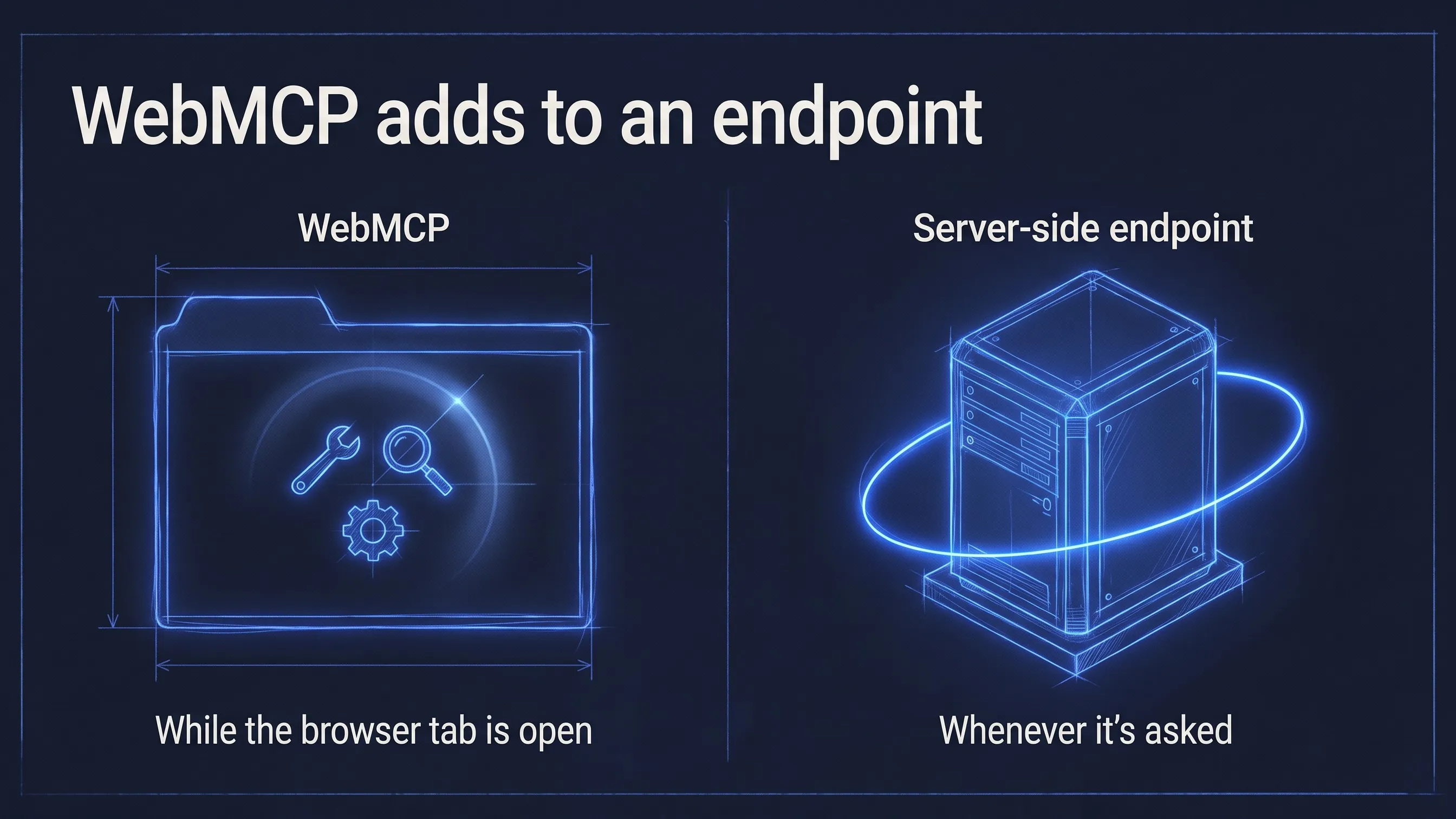
WebMCP is the browser-based version of the idea: the page itself offers tools to an agent working in the browser. It’s now called document.modelContext, and Chrome is testing it through version 156 in an origin trial, which lets sites try a new feature early. Its tools only work while the browser tab is open, whereas a server-side endpoint answers whenever it’s asked, so WebMCP adds to an endpoint rather than replacing it. Shopify has already switched it on: since August 2026 its WebMCP tools are live on every Liquid storefront.
Discovery: MCP Server Cards
An agent can only use a site’s MCP server if it knows where to find it. MCP Server Cards are the answer the MCP project settled on: a site publishes an AI Catalog at /.well-known/ai-catalog.json that links to or embeds a Server Card for each of its MCP servers, and each card says how to connect. The proposal, written on behalf of the Server Card Working Group, became final on 6 October 2026. Mintlify already advertises its servers through /.well-known/mcp. Until agents and sites catch up, someone usually still has to give the agent the address.
What none of them does yet
Step back and the picture is uneven. The built-in options only cover their own platforms. The hosted ones ask you to put your domain on Cloudflare, take on a chatbot product, or build on a search service such as Azure AI Search; Yext and Algolia also run hosted MCP servers over the data you keep with them, both in beta. The CMS plugins are mostly editing tools that need a login, and the docs tools only cover documentation. The crawl-to-MCP tools are run by whoever is using the agent, not by the site owner. Outside docs sites, NLWeb is still the main open project built as a public “ask this site” endpoint that the owner publishes.
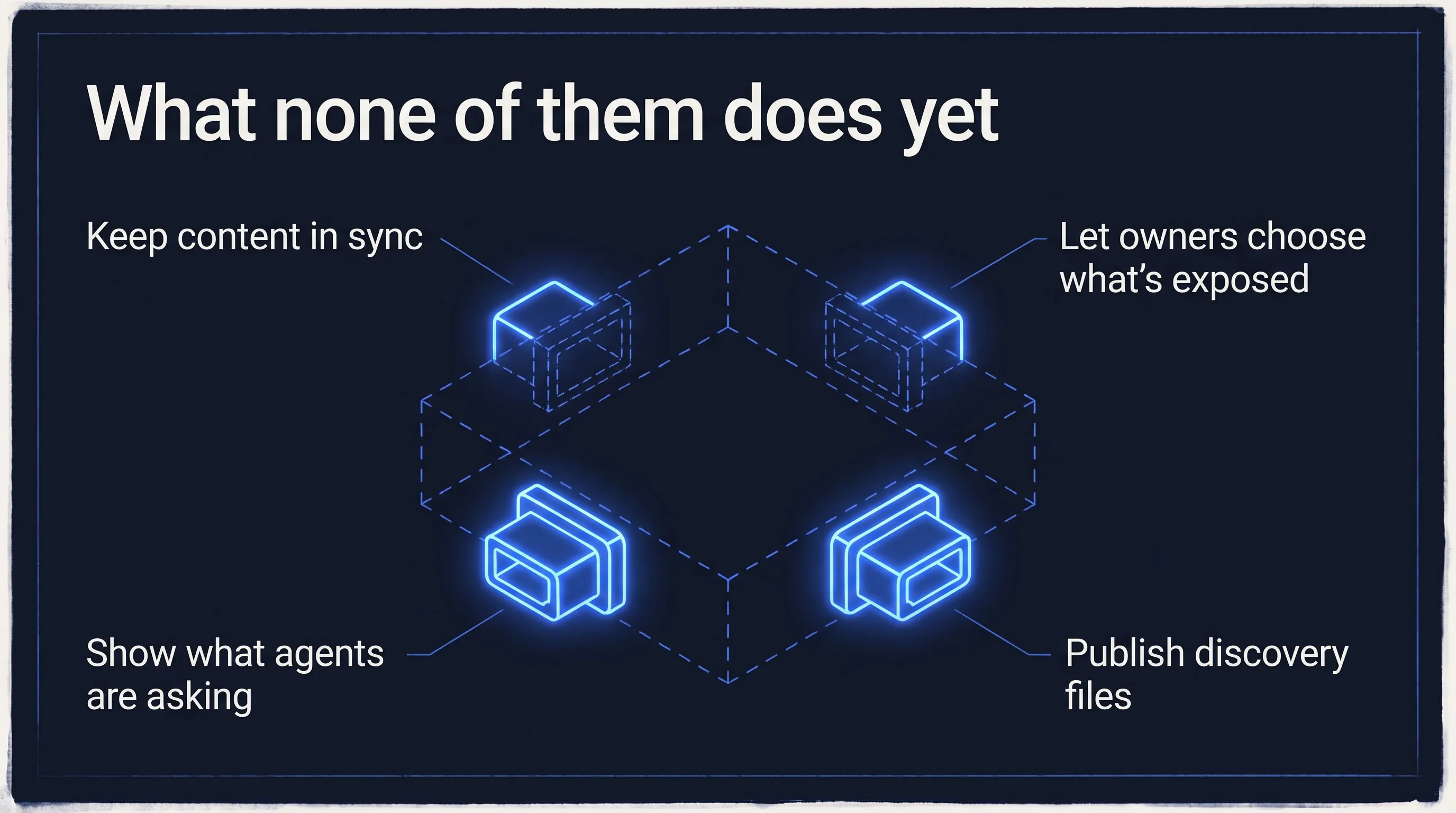
What I didn’t find is a clear leader for a layer that works on any platform and that the site owner controls, especially for WordPress, custom-built and enterprise CMS sites. That layer would need to do four things:
- keep content in sync,
- let owners choose what’s exposed,
- show what agents are asking,
- publish discovery files.
The closest I saw is SiteToMCP, which pitches exactly this: one script tag on any stack, WordPress included, an allowlist of what agents can see, audit logs and analytics, and automatic discovery. It’s in closed beta, so I couldn’t judge how well it works. Kapa.ai already shows owners what developers and agents ask through its server, but it’s aimed at docs and knowledge bases. Open-source options remain thin for a version that works on any platform and handles crawling, keeping content current, access rules and discovery.
Method and caveats
- The search was an AI assistant’s web search in the first week of October 2026, followed by a second, wider pass over open-source projects. I checked every claim against the product’s own documentation, changelog or canonical repository on 7 October 2026, and a second check tried to overturn each claim the first one couldn’t confirm.
- Where the documentation disagreed with the search (Shopify’s endpoints, the Server Card proposal’s status, Dify, Elastic, Azure AI Search, Drupal’s MCP Server module, docusaurus-plugin-mcp, RAGFlow and Kapa’s connector count), this article follows the documentation. sitemcp and mcpdoc are archived and are listed as such.
- Two tools from the search are left out: AnyDocs MCP, whose repository no longer exists, and AgentLayer, a demo with no public repository.
- Where the search cited a fork or a directory listing, the links here go to the canonical repository or the vendor’s documentation.
- Nothing was installed or run, so this reviews what each tool documents, not how well it works. SiteToMCP and Yext’s and Algolia’s servers are described from their own pages.
- The count of 44 takes a search engine and its crawler as one tool (Meilisearch with scrapix, Elastic’s Open Crawler with Agent Builder) and each Drupal module on its own. The two standards and the three services named in the last section aren’t counted.