Writing
Notes from my own research, for engineers building the same things: MCP servers, AI tooling for codebases, and the IoT and machine-learning work that came before.
2026
Open-source personal agents in 2026: OpenClaw, Hermes Agent and four more, compared Six open-source, always-on personal AI agents compared: OpenClaw, Hermes Agent, Nanobot, ZeroClaw, NanoClaw and IronClaw, and which fits what.
Visually validating vector data for RAG How I inspect my website’s embeddings with projection maps, exact neighbors and chunk diagnostics, and where visual checks need retrieval tests.
Two reference architectures for an MCP server: minimal cost and enterprise scale Two reference architectures for the same MCP search service: a small Azure deployment and an Azure-only enterprise proposal, with diagrams and costs.
Decision models against small LLMs: Jev, Kev, Laya and Mammoth-1 on 6,662 decisions Four decision models and five small LLMs on the same 6,662 decisions: accuracy, calibration, format failures, latency and cost, every call published.
Validating a vector database built for RAG: four layers of checks, with the code to run them How to check a RAG vector index on its own, in four layers from the chunks to the answer, with runnable Python and 25 evaluation tools compared.
RAG, CAG, KAG and the search beneath them: which fits which problem in 2026 RAG, CAG, KAG and the search beneath them, from BM25 to graphs, compared on the published evidence, with a guide to which fits which problem.
How MCP extensions work MCP extensions are optional additions, off by default: which exist in October 2026, how both sides negotiate them per request, and how a server falls back.
MCP Apps: how interactive UI gets into the conversation MCP Apps puts interactive HTML inside the chat: how the server, the host and the sandboxed view share the work, and the messages up to the first render.
Building an MCP App: declarations, sandbox and text fallbacks What an MCP App’s server declares, how its view talks to the host, how web hosts sandbox it, and a Python tool with a text fallback plus a TypeScript view.
MCP Tasks: long-running work without holding a connection How the MCP Tasks extension answers a tool call with a task the client polls: its states and methods, durable storage, security, and a Python type.

Skills over MCP: shipping workflows with your server How an MCP server publishes Agent Skills over skills/list and skills/get, the SHA-256 manifest hosts verify, when approval applies, and a Python builder.
Enterprise-managed authorization and client credentials for MCP Two official MCP authorization extensions: enterprise access through an ID-JAG from the company’s IdP, and client credentials for jobs with no user.
Experimental and vendor-specific MCP extensions What vendor _meta keys like anthropic/alwaysLoad do, why they must stay optional, what Interceptors and Variants propose, and when to build your own.
One request through an MCP server, end to end One MCP request followed through seven phases, from server/discover to the app’s teardown, then tested in Python with a fake host and a wire recorder.
Which AI hosts support which MCP features (October 2026) Which MCP features Claude, Claude Code, ChatGPT, VS Code, Cursor, Gemini CLI and Microsoft 365 Copilot support, and what that means for your server.
MCP server design patterns and anti-patterns Four MCP server design patterns that hold up, from search plus fetch to layered surfaces, and the twelve anti-patterns behind most production problems.
Should you put an AI agent behind an MCP tool? When an inner agent behind an MCP tool helps, when plain search and fetch tools serve the calling model better, and eleven design rules if you build one.
A reference architecture for MCP servers in production How the 2026 MCP duties shape a production deployment: a generic architecture, one way to host it on Azure, and a build pipeline for MCP’s own artifacts.
The MCP server author’s checklist A one-page checklist for MCP server authors, from server/discover to deprecations, each item linked to the series article that explains it.
What to require from an MCP server vendor: a buyer’s checklist The questions to put to an MCP server vendor before you sign, drawn from the 2026-07-28 specification, and what a good answer to each looks like.
An MCP governance checklist for the CTO The decisions a CTO has to make before MCP servers reach a company’s AI tools, from who controls each primitive to what the host must enforce.
MCP maturity in October 2026: what’s stable, what’s deprecated, what’s still a bet Which parts of MCP a buyer can rely on in October 2026: five revisions of the specification, what 2026-07-28 removed, and where each extension stands.
MCP host coverage: will the server work in the AI apps your company uses? Tools on a remote server are the only MCP surface all seven hosts support, so check a server against the AI apps your company runs before you buy it.
Your MCP server is an OAuth resource server: what it must do An MCP server is an OAuth 2.1 resource server with four duties: publish its metadata, send the 401, validate every token, and forward none of them.
MCP authorization in practice: step-up, no passthrough, Entra ID How an MCP server asks for more scope with a 403 step-up, calls other APIs without passing tokens through, and works with Microsoft Entra ID.
Tracing MCP calls with OpenTelemetry How an MCP server continues a trace from traceparent in _meta, which spans and attributes to emit, what to measure, and what the Python SDK traces for you.
An MCP threat model: what to defend, and where The threats an MCP deployment faces, from tool poisoning to token passthrough, its three trust boundaries, what the spec requires, and layers of defence.
Serving two MCP protocol eras: deprecations and a migration checklist How one MCP server serves 2025-era and 2026-07-28 clients at once, what is deprecated and until when, what is gone, and a migration checklist.
Multi round-trip requests: how a stateless MCP server asks for more How a stateless MCP server asks for a confirmation without a session: the input_required result, the retry, the rules for both sides, and a Python example.
requestState: sealing the state your MCP server hands to the client Why an MCP server must seal the requestState it hands the client, what to bind into it, what the Python SDK seals for you, and how to build a wizard on it.
Elicitation in MCP: asking the user with a form or a link How an MCP server asks the user through the host: form and URL elicitation in multi round-trip requests, capability checks, and a sign-in link in Python.
Progress, cancellation and timeouts when nothing can resume How an MCP server reports progress, honours cancellation on stdio and Streamable HTTP, and lives with timeouts when a dropped stream can’t resume.
subscriptions/listen: change notifications in MCP How an MCP server streams change notifications with subscriptions/listen: the filter, acknowledgement first, reconnects and fan-out across instances.
Open-source AI chat apps in 2026: 51 mapped, 12 compared, and which fits what Fifty-one open-source alternatives to the ChatGPT and Claude apps, mapped by GitHub stars and activity, twelve compared, and a pick for eight uses.

Making a website AI friendly: what the bots actually fetched from mine What AI crawlers actually fetched from this site in 18 days: pages, robots.txt and the sitemap most of all, and llms.txt never by a verified crawler.
An LLM-friendly website checklist: eight steps and a test for each Eight steps to make a website easy for AI crawlers and agents to read, in the order the bots fetched them, each with a command to check your own site.
Designing an MCP tool: the definition and the result What an MCP tool definition and its result carry: naming rules, annotations, content and structuredContent, with a Python weather tool.
MCP tool errors, and tools that models use well When an MCP tool should return isError and when a protocol error, what the Python SDK does with exceptions, and how to design tools models use well.
MCP resources: context the application decides to use How an MCP server lists and reads resources and URI templates, the error a missing resource gets, and what hosts and the Python SDK do with them.
MCP prompts: slash commands your server ships How MCP prompts work: how hosts invoke them, prompts/list and prompts/get, argument completion, safe arguments and a Python example.
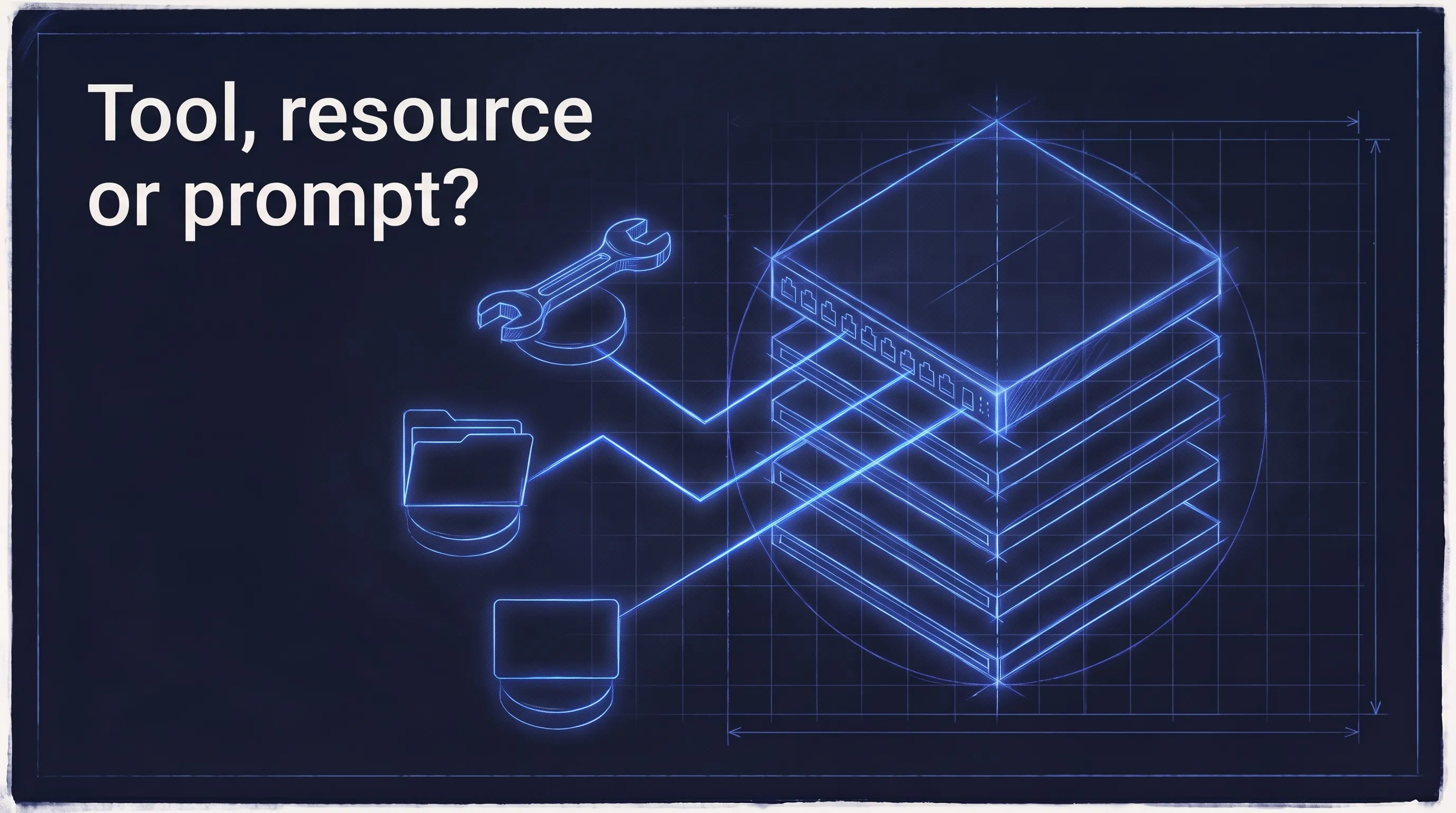
Tool, resource or prompt? Choosing the right MCP primitive Tools, resources and prompts differ in who decides when they’re used: how to pick an MCP primitive, and where instructions, Skills, Apps and Tasks fit.
What an MCP server does in 2026: much more than a list of tools What an MCP server does in 2026: three roles, duties against features and extensions, one request traced through, and a one-tool Python server.
MCP goes stateless: what changed in the 2026-07-28 specification The 2026-07-28 MCP spec drops the handshake, sessions and server-initiated requests: what replaces them, what else changed, and what is deprecated.
server/discover: the one method every MCP server must implement server/discover is the one method every 2026-07-28 MCP server must implement: what it returns, and how a client negotiates a version or falls back.
Server instructions: the paragraph every model reads first What MCP server instructions are, how hosts such as Claude Code load them, and what to write and what to leave out, with a Python example.
Stateless MCP requests: _meta, resultType and explicit handles Every 2026-07-28 MCP request carries its version and capabilities in _meta: how a client branches on resultType and how a server keeps state in handles.
Caching hints and pagination in MCP Six MCP methods' results must carry ttlMs and cacheScope: how the caching hints work, why tool order should stay stable, and how cursor pagination works.
MCP transports in 2026: stdio and Streamable HTTP How MCP’s two transports work: stdout on stdio, the headers that route a Streamable HTTP request, x-mcp-header, and proxy timeouts.
MCP servers for websites in 2026: 44 tools, sorted by who runs them Forty-four ways to let an AI agent search and ask a website over MCP, from Wix and Shopify to NLWeb and CMS plugins, sorted by who runs the server.
AI tools that document a codebase in 2026: 17 compared, and what none of them does yet Seventeen tools that turn a repository into documentation, compared on what each reads and produces and who it serves, and the gaps none of them fills.
Observed, documented, inferred: a design for codebase documentation you can audit A design for documentation generated from code where every fact carries evidence and a label, observed, documented or inferred, so readers can audit it.
Testing MCP servers in 2026: 31 tools compared and the gaps between them Thirty-one tools that inspect, test, audit, secure or load test an MCP server, compared on twelve capabilities, and the gaps none of them fills.
One MCP server, eight rulebooks: what the spec, Claude, ChatGPT, Codex, VS Code, Windsurf, Kiro and Gemini CLI require The checkable rules each AI host applies to an MCP server, from tool-name length to mandatory annotations, where they conflict, and what validates them.
2018
Getting IoT device data to the cloud: webhooks, device management and testing How a webhook carries sensor data, what managing a fleet of IoT devices involves, and what to test before a full deployment. From 2018.
Bluetooth Low Energy fundamentals: how it saves power and reaches the internet How Bluetooth Low Energy saves power, which devices can talk to which, how a sensor reaches the internet, and what mesh adds, as it stood in 2018.
BLE beacons in practice: protocols, sensors, layout and transmission power Four decisions in a Bluetooth beacon deployment, from 2018: iBeacon or Eddystone, which sensors, point or grid layout, and how much transmission power.
Indoor location: RTLS, asset tracking, beacons and ultra-wideband What makes a tracking system real-time, which technologies an RTLS can run on, and when to choose Bluetooth beacons or ultra-wideband, from 2018.
2017
Recognizing handwritten digits: six neural networks on MNIST, from 92% to 99.4% Six TensorFlow models for the MNIST digits, from 2017: one softmax layer at 92%, up to a convolutional network with batch normalization at 99.4%.
A first try at sentiment analysis: TextBlob on a Twitter stream A weekend experiment from January 2017: reading a live Twitter stream with Tweepy and scoring each tweet with TextBlob, in about thirty lines of Python.